E-commerce and Affiliate Marketing Shaping Online Income in the Digital Age
March 2, 2026
E-commerce and Affiliate Marketing Shaping Online Income in the Digital Age
Nowhere else shows growth like the online marketplace — it’s become essential infrastructure for today’s companies. In field after field, people launching ventures, working jobs, or exploring web-based earnings now lean on e-commerce and affiliate marketing to create lasting revenue.
Folks around the world now shop much more online, pushing companies to pour effort into e-commerce marketing strategies aimed at lasting connections, not just quick transactions. Meanwhile, newcomers test the waters through affiliate marketing for beginners—simple starting spots with little upfront cost.
Folks find new paths to income thanks to these two models working side by side.
Starting fresh at places such as Learn Digital Marketing Pro, people begin seeing how these systems fit—less like separate moves, more like pieces building one path forward through digital marketing for e-commerce.
What are E-commerce and Affiliate Marketing?
E-commerce and affiliate marketing are no longer trends. They are foundational to modern digital success. What keeps companies growing also helps people make money. Not only do these tools adapt to demand, but they also build steady progress over time. Rather than chasing quick wins, users shape lasting financial balance through consistent effort.
Right now, getting bigger online means nailing the mix of digital marketing for e-commerce and pay-for-results collaborations. What matters most is how well companies link these two pieces together. Success hides in the details of execution, not just having both. Some miss it by treating them separately.
Others gain ground by aligning goals early. The real shift happens when campaigns feed partner efforts directly. Without that flow, results stall. Stronger outcomes come from shared data, not isolated wins. Timing also plays a quiet role—launches sync best when both sides move at once. Progress shows up fastest where trust replaces rigid contracts. While e-commerce builds ownership and control, affiliate marketing opens doors to reach, trust, and expansion—without the heavy upfront investment traditional models demand.
With the right knowledge and structured guidance, anyone can move beyond participation—toward sustainable growth in today’s digital economy. Those who understand how to align an e-commerce strategy with affiliate marketing for beginner ecosystems are better positioned to build consistent income streams that evolve with changing technology and consumer behavior.
E-commerce Growth Accelerates
Shopping habits have shifted dramatically. Today’s buyers prefer:
Convenience
Price comparison
Faster delivery
Personalized experiences
This drives companies toward online store marketing to attract and retain customers. But visibility alone isn’t enough. Competition is intense. Businesses rely heavily on digital marketing for e-commerce, including
Search engine presence
Social media marketing
Email campaigns
Content creation
Influencer partnerships
And increasingly, affiliate marketing strategies.
The Role of Affiliate Marketing in E-commerce Success
Affiliate marketing is no longer just referral links. It is now a structured growth channel. Brands collaborate with:
Bloggers
Influencers
Online educators
Community leaders
Through strategic partnerships, companies expand reach without heavy upfront advertising costs. This performance-based model creates balance:
Brands pay only for results
Affiliates earn from impact
Many beginners begin by exploring the best affiliate programs for beginners before launching their own e-commerce ventures.
How Affiliate Marketing Actually Works
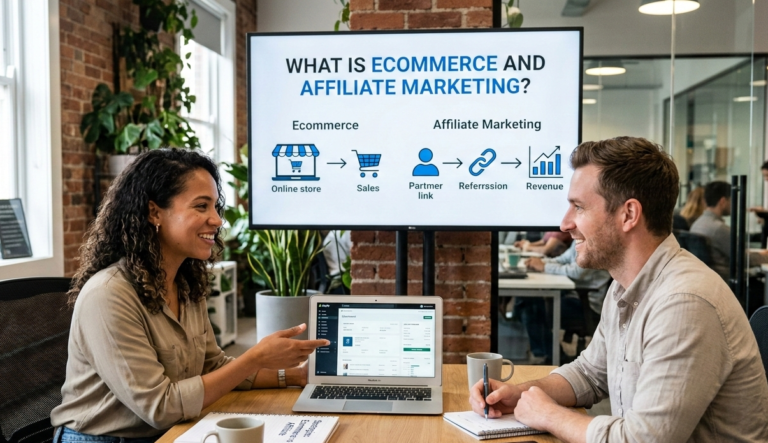
Out of nowhere, a workout gear company drops a new item—not just tossing cash into online ads but linking up with social media trainers and health-focused creators instead. These partners spread the word with special links you can trace straight to their posts. If someone buys it? The person who shared gets paid a slice. Because it runs on results, the system keeps working even while everyone sleeps—old clips and last month’s reviews are still racking up small earnings here and there. Over time, those bits add up without needing fresh effort through passive income through affiliate marketing.
E-commerce and Affiliate Marketing Together
Out of nowhere, a workout gear company drops a new item—not just tossing cash into online ads but linking up with social media trainers and health-focused creators instead, a model increasingly seen in e-commerce and affiliate marketing. These partners spread the word with special links you can trace straight to their posts. If someone buys it? The person who shared gets paid a slice. Because it runs on results, the system keeps working even while everyone sleeps—old clips and last month’s reviews are still racking up small earnings here and there. Over time, those bits add up without needing fresh effort.
Skills Needed to Get Ahead
Getting ahead here has nothing to do with chance – it’s shaped by clear planning, particularly if you’re working in online stores or referral selling. Figuring out what buyers really want comes first, then shaping messages that hit right, knowing how platforms push visibility, plus tapping into what drives purchases. Step-by-step study helps uncover markets worth entering, craft compelling copy, bring in the correct visitors, while fine-tuning paths to buying. Growth that lasts? Built on these abilities.
Common Challenges Without Knowledge
Most new starters struggle with weak visits, few sales, and fewer earnings—mainly due to unclear markets, vague audiences, and scattered messaging. E-commerce and affiliate marketing training course newcomers tend to run on excitement alone, skipping clear plans entirely. A steady method turns attention from quick wins to lasting growth, letting progress build slowly but steadily.
Why Digital Training Matters
The digital landscape evolves constantly.
Platforms change
Algorithms shift
Buyer behavior evolves
Training helps individuals learn:
How to build scalable systems
How to choose profitable partnerships
How to integrate digital marketing for e-commerce
Knowledge turns trial into strategy.
Opportunities in India & Global Market
Across India, businesses invest in:
Online storefronts
Influencer collaborations
Affiliate partnerships
This creates opportunities for:
Entrepreneurs launching stores
Individuals seeking passive income through affiliate marketing
Professionals skilled in both e-commerce and affiliate systems become increasingly valuable.
The Future of Ecommerce & Affiliate Marketing
Smarter tools keep changing how products get suggested, who sees them, and how sales improve. Still, one thing remains clear: real results come from genuine relationships. Those using online business in India alongside online shops and partner promotions tend to rise above the rest, especially when teamwork boosts exposure and earns confidence, because long-term income often follows where attention flows naturally. Amid growing digital noise, standing out happens less by shouting and more by linking meaningfully. Progress comes not just from systems but from shared efforts behind the scenes.
Ecommerce and affiliate marketing are no longer trends. They are foundational to modern digital success. What keeps companies growing also helps people make money. Not only do these tools adapt to demand, but they build steady progress over time. Rather than chasing quick wins, users shape lasting financial balance through consistent effort.
Right now, getting bigger online means nailing the mix of digital marketing for ecommerce and pay-for-results collaborations. What matters most is how well companies link these two pieces together. Success hides in the details of execution, not just having both. Some miss it by treating them separately. Others gain ground by aligning goals early. The real shift happens when campaigns feed partner efforts directly. Without that flow, results stall. Stronger outcomes come from shared data, not isolated wins. Timing also plays a quiet role – launches sync best when both sides move at once. Progress shows up fastest where trust replaces rigid contracts. While ecommerce builds ownership and control, affiliate marketing opens doors to reach, trust, and expansion — without the heavy upfront investment traditional models demand.
With the right knowledge and structured guidance from LDMPro, anyone can move beyond participation — toward sustainable growth in today’s digital economy. Those who learn how to align ecommerce strategy with affiliate ecosystems through practical, real-world training are better positioned to build consistent income streams that evolve alongside changing technology and consumer behavior.